
 TYSAS Desk
06, Oct 2026
20 min read
TYSAS Desk
06, Oct 2026
20 min read
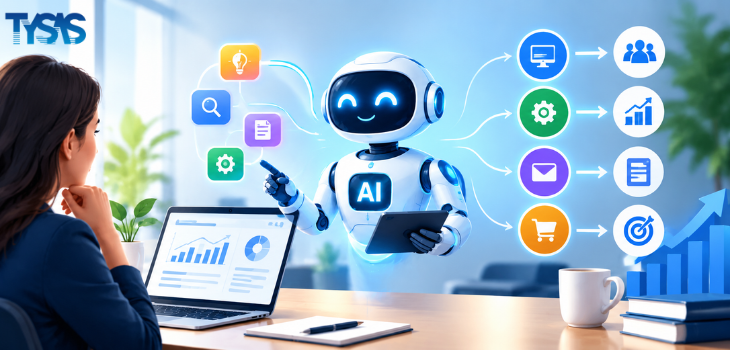
Artificial intelligence is changing the way businesses work, communicate with customers, and manage everyday tasks. From customer support to marketing and software development, AI is becoming part of everyday business operations.
One of the newer developments in AI is Agentic AI. Unlike traditional software that follows fixed instructions or basic AI tools that simply respond to prompts, Agentic AI is designed to work toward a specific goal by planning actions, using tools, and making decisions based on the information available to it.
For businesses, Agentic AI can create new opportunities to automate repetitive processes, improve customer experiences, support employees, and make digital systems more efficient.
In this guide, we will explain what Agentic AI is, how it works, its benefits, business use cases, challenges, and how it can be connected with modern website and digital solutions.
Agentic AI refers to artificial intelligence systems that are designed to work toward a particular goal with a certain level of autonomy.
Instead of only answering a single question, an AI agent can be designed to understand an objective, break it into smaller tasks, use connected tools or systems, review results, and continue working toward the desired outcome.
For example, a basic chatbot may answer a customer's question about an order.
An agentic AI system could potentially identify customer, access the relevant order information, check the current status, and provide an appropriate response.
The actual capabilities depend on the system, integrations, permissions, and business rules provided to the AI.
Agentic AI generally works through a series of connected steps.
Understanding the Goal: The system first receives a task or objective and interprets what the user or business wants to achieve.
Planning the Task: AI determines which actions may be required to complete the objective. A complex request may involve several smaller steps.
Using Tools and Data: Depending on its design, an AI agent can interact with databases, APIs, CRM systems, websites, business applications, or other approved tools.
Making Decisions: system evaluates available information and determines what action should happen next based on its instructions and objectives.
Checking the Results: After completing an action, the system can review the result and determine whether another step is required.
Completing the Goal: Once the required steps are finished, the AI provides the result or sends the information to the appropriate person or system.
Generative AI and Agentic AI are connected technologies, but they have different primary purposes.
Generative AI is mainly designed to create content or provide responses. It can write articles, summarize information, generate code, create ideas, and answer questions.
Agentic AI focuses more on completing a goal through multiple actions.
For example:
Generative AI: Write a follow-up email for a customer.
Agentic AI: Identify customers who need a follow-up, review available information, prepare an appropriate message, and send it through an approved workflow.
This ability to work through multiple connected steps is one of the main characteristics of Agentic AI.
Businesses are constantly looking for ways to reduce repetitive work, improve efficiency, and provide faster customer service.
Agentic AI can support these goals by connecting different tasks into automated workflows.
Instead of employees manually completing every small step, an AI system can potentially handle routine activities while people focus on work that requires creativity, strategy, communication, and judgment.
1. Automates Repetitive Tasks: Businesses often spend time handling repetitive activities such as data entry, customer questions, appointment requests, reports, and follow-ups.
2. Improves Customer Support: AI agents can help customers find information, answer common questions, check basic details, and navigate business services.
3. Saves Time: When multiple manual tasks are connected into one workflow, businesses may reduce the time employees spend moving information between different systems.
4. Supports Lead Management: AI agents can help collect enquiries, organize lead information, identify basic requirements, and route potential customers to the appropriate sales team.
5. Improves Business Productivity: Employees can spend less time on repetitive administrative tasks and more time on important activities such as sales, strategy, customer relationships, and creative work.
6. Provides Personalized Experiences: When properly integrated with customer information, AI systems can provide more relevant responses and recommendations.
Agentic AI is not limited to large companies. Small and medium-sized businesses can also explore practical applications.
Common examples include:
The best approach is to start with one specific business problem rather than trying to automate every process at once.
For example, a company receiving hundreds of similar customer enquiries every month could explore an AI-powered customer support workflow.
Role of AI is also expanding within website development.
Modern websites can include AI-powered features such as virtual assistants, smart search, automated enquiry handling, product recommendations, and personalized customer experiences.
When businesses invest in website design services, they can consider AI features alongside important website requirements such as:
AI should not be added simply because it is popular. A website should use AI when it provides a clear benefit to customers or the business.
For example, a website development service could include an AI assistant that helps visitors understand different services, answers common questions, and guides potential customers toward submitting an enquiry.
Agentic AI can also support different areas of digital marketing.
Marketing teams can use AI systems for tasks such as:
For example, an AI-powered workflow could collect marketing campaign information, identify important performance changes, summarize the findings, and prepare a report for a marketing manager.
Human review is still important when AI is involved in advertising budgets, customer information, brand communication, or important business decisions.
Customer service is one of the areas where AI agents can provide practical benefits.
An AI agent can potentially help customers with common requests such as:
For more complicated requests, the system can pass the conversation to a human representative.
This creates a combination of automated assistance and human support.
Although Agentic AI offers many possibilities, businesses should also understand its limitations.
Accuracy: AI systems can misunderstand information or make incorrect decisions, particularly when data is incomplete or unclear.
Security: Businesses need to carefully control what systems an AI agent can access and what actions it is allowed to perform.
Privacy: Customer and business information should be handled responsibly. Access to sensitive data should be limited and properly managed.
Human Oversight: Important decisions should not always be fully automated. Businesses should establish appropriate approval processes and monitoring.
Implementation Cost: Building and integrating an AI agent with existing business systems can require technical planning, development, testing, and ongoing maintenance.
Businesses interested in Agentic AI can begin with a simple approach.
Step 1: Identify a repetitive business task.
Step 2: Define desired outcome.
Step 3: Determine what information and systems the AI would need.
Step 4: Set clear permissions and limitations.
Step 5: Test the workflow with a small use case.
Step 6: Monitor performance and improve the system.
This approach can help businesses understand the practical value of AI before expanding it to more complex processes.
TYSAS helps businesses build their digital presence through website design, website development, digital marketing, and technology solutions.
Professional website design should focus on more than appearance. A business website should provide a smooth user experience, work properly on mobile devices, load efficiently, and make it easy for customers to understand the company's services.
TYSAS website design services can help businesses create a professional online presence that supports their branding and digital marketing goals.
Businesses looking for a website development service can also explore features such as CRM integration, enquiry forms, automation, analytics, AI assistants, and other customized functionality based on their requirements.
Right solution depends on the business model, target audience, workflow, budget, and long-term objectives.
Agentic AI is expected to become an increasingly important part of business technology as AI models, automation platforms, and software integrations continue to develop.
Businesses may use AI agents to support different departments, including sales, customer service, marketing, operations, and administration.
However, the future is not necessarily about replacing humans with AI.
A better approach for many businesses will be combining AI automation with human expertise.
AI can handle repetitive tasks and process large amounts of information, while people can provide creativity, strategic thinking, empathy, judgment, and accountability.
Agentic AI is changing the way businesses think about artificial intelligence and automation.
Instead of simply generating an answer, an AI agent can be designed to understand a goal, plan actions, use approved tools, and complete multiple steps toward an outcome.
For businesses, this can create opportunities to improve productivity, customer support, lead management, marketing, and everyday operations.
However, successful AI implementation requires proper planning, reliable data, security controls, clear permissions, and human oversight.
Whether you are planning a new website, improving your existing digital presence, or exploring AI-powered business automation, the most important question should be simple:
How can this technology solve a real business problem?
When used with the right strategy, Agentic AI can become a practical business tool rather than simply another technology trend.







Lorem ipsum dolor, sit amet consectetur adipisicing elit. Molestiae modi impedit iure ducimus dolore eligendi provident praesentium nihil, nesciunt soluta.