
 TYSAS Desk
18, Nov 2026
30 min read
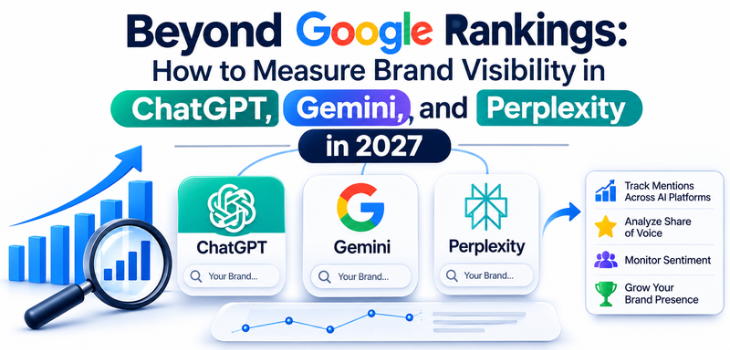
For years, businesses have focused on one major goal in digital marketing: achieving higher rankings on Google. Marketers have invested time and resources in keyword research, link building, technical SEO, and content optimization to bring more visitors to their websites.
But the way people search for information is changing.
Today, users are increasingly exploring AI platforms such as ChatGPT, Google Gemini, and Perplexity to explore businesses, compare services, study products, and find answers to everyday questions.
Instead of clicking through multiple search results, users can receive summarized answers, recommendations, and website references directly from AI platforms.
This shift creates a new dare for businesses. Ranking on Google is still important, but brands also need to understand whether they are being discovered, mentioned, and recommended in AI-generated answers.
This is where AI search visibility becomes important.
In 2027, businesses need to look beyond traditional search engine rankings and understand how their brands appear across different AI search platforms.
In this guide, we will explore how to evaluate brand visibility in ChatGPT, Gemini, and Perplexity, which metrics matter, and how businesses can improve their presence in the evolving AI search landscape.
AI search visibility refers to how often and accurately a brand, website, product, or business appears in responses generated by AI-powered search and answer platforms.
Traditional SEO mainly focuses on improving a website's position in search engine results pages (SERPs). AI search visibility focuses on whether AI platforms recognize a brand as a relevant source when responding to user queries.
For example, imagine someone asks an AI platform:
"Which is a reliable website design company for small businesses?"
If your company appears in the AI-generated recommendations or is referenced as a relevant source, your brand has gained visibility within that response.
However, AI visibility is not limited to brand recommendations. It can also include:
The important point is that AI search visibility measures how your business is discovered beyond conventional search rankings.
Why Google Rankings Are No Longer the Only SEO Performance Indicator
Google rankings remain an important part of SEO, but modern search behaviour is becoming more diverse.
Customers now use different platforms depending on their research requirements.
For example:
This means businesses should not depend on a single search visibility metric.
A website may rank well on Google but receive very few brand mentions in AI-generated responses. Similarly, a business may appear in AI recommendations even when users do not directly click its website.
That is why a broader measurement strategy is becoming increasingly important.
Understanding Brand Visibility Across ChatGPT, Gemini, and Perplexity
Each AI platform offers a different search and discovery experience. Businesses should understand these differences before creating an AI visibility measurement strategy.
<PRIVATE_PERSON> is an AI-powered conversational platform that helps users find information, explore topics, and compare different products and services.
When users ask questions related to your industry, ChatGPT may generate answers that mention relevant companies, services, or websites.
For example:
"Recommend a top website design company that also provides SEO and digital marketing services."
If your brand appears in the response, it indicates an opportunity to build awareness through AI-powered discovery.
How to measure ChatGPT visibility:
Businesses should test a consistent set of relevant questions over time rather than relying on a single search.
Google Gemini is Google's AI platform that supports information discovery, research, and conversational interactions.
For businesses, Gemini creates another opportunity to be discovered through AI-powered answers.
Consider a user searching:
"Which digital marketing services can help a startup generate more qualified leads?"
If Gemini references your website, brand, or services in a relevant answer, it can contribute to brand discovery.
How to measure Gemini visibility:
It is important to distinguish Gemini app visibility from Google Search AI Overviews. They are different search experiences and should be monitored separately.
Perplexity is an AI-powered answer engine that provides conversational responses supported by source references.
It is particularly useful for users researching topics, exploring solutions, and comparing different businesses.
For example:
"What should I look for when hiring an SEO company for my business website?"
Perplexity may provide an answer with supporting references to relevant websites.
How to measure Perplexity visibility:
Perplexity citations can offer useful insights into which pages and content topics are being referenced in AI-generated answers.
Measuring AI visibility requires a different approach from traditional SEO reporting.
Instead of focusing only on keyword rankings and organic traffic, businesses should monitor several indicators that provide a clearer picture of their AI search presence.
Brand mention rate measures how frequently your company appears in AI-generated responses for a defined set of relevant questions.
For example, if your brand appears in 20 out of 100 tested AI responses, your brand mention rate is 20%.
Formula:
Brand Mention Rate = (Responses Mentioning Your Brand / Total Responses Tested) × 100
This metric helps businesses understand how often AI platforms recognize their brand.
Citation frequency measures how often AI platforms reference your website as a supporting source.
For example, if your website receives 15 citations across 100 relevant queries, you can use that information to evaluate your citation presence.
It is useful to track citations separately from general brand mentions because a brand may be mentioned without its website being linked.
AI Share of Voice compares your brand's visibility with competing businesses across a defined set of AI search queries.
For example, if your company receives 25% of all brand mentions recorded across a competitor group, your AI share of voice is 25%.
This helps marketers understand how their business performs against competitors in AI-generated answers.
AI referral traffic measures website visits originating from AI platforms.
Businesses can use Google Analytics 4 (GA4), referral reports, and available campaign tracking information to identify traffic from sources such as ChatGPT and Perplexity.
However, not every AI-driven visit will have a clearly identifiable referral source. Some visits may appear as direct traffic or remain unattributed.
Traffic alone does not determine marketing success.
Businesses should also monitor whether AI-referred visitors complete meaningful actions, such as:
This connects AI search visibility with actual business performance.
Understanding your competitors' AI visibility can help identify opportunities to improve your content and brand authority.
Monitor which competitors appear frequently in responses related to your industry and examine the topics where they receive greater visibility.
This can help uncover content gaps and new keyword opportunities.
Brand visibility is not valuable if AI platforms display incorrect information about your company.
Check whether AI-generated responses accurately represent your:
Correct and consistent business information can help reduce confusion during customer discovery.
Prompt coverage measures how many relevant questions from your target query list generate a brand mention or citation.
For example, a website development company may test prompts related to:
This helps determine which business topics are generating visibility and which require improvement.
This metric identifies which website pages are being referenced by AI platforms.
For example, an educational blog about website development may receive more citations than a general service page.
Tracking cited URLs helps marketers understand which content provides useful information to AI systems.
Brand sentiment helps evaluate how your business is presented in AI-generated responses.
Check whether your brand is described positively, neutrally, or negatively.
Also review whether AI platforms communicate your services, expertise, and business strengths correctly.
This is particularly important for companies that want to establish trust and credibility in competitive industries.
Traditional SEO and AI search optimization have different measurement approaches, but they should work together.
Traditional SEO helps businesses improve their visibility in search engines, while AI visibility measurement provides additional insights into how brands appear in conversational search experiences.
A balanced strategy should include both.
Businesses do not need a complicated measurement system to start monitoring their AI search presence.
A structured approach can help marketers understand their current visibility and identify areas for improvement.
Step 1: Identify Your Important Business Topics
Start by listing the topics and services your customers search for.
For example, a digital technology company may focus on:
These topics will form the foundation of your AI visibility research.
Step 2: Create a List of Relevant AI Search Prompts
Develop realistic questions that potential customers may ask ChatGPT, Gemini, and Perplexity.
Examples:
Use the same prompts across platforms to make comparisons more meaningful.
Step 3: Test Your Prompts Across AI Platforms
Run your selected questions on ChatGPT, Gemini, and Perplexity.
Record results, including:
Remember that AI responses can vary by time, context, location, model version, and available web-search features.
Step 4: Create an AI Visibility Tracking Sheet
Maintain a spreadsheet to record your observations.
Suggested tracking columns:
This creates a consistent record for future comparisons.
Step 5: Analyze Website Traffic and Conversions
Use Google Analytics 4 to review identifiable referral traffic from AI platforms.
Track relevant landing pages, engagement, lead submissions, and conversions.
You can also use Google Search Console to monitor traditional search performance and compare it with broader AI discovery trends.
Step 6: Identify Content Gaps
If competitors frequently appear in AI-generated responses but your brand does not, investigate the difference.
Review their:
Use these findings to improve your own content strategy.
Step 7: Review Results Regularly
AI search visibility is not a fixed metric.
Repeat your tests using the same prompts and comparable conditions. Monthly tracking can provide a useful starting point for identifying changes and evaluating optimization efforts.
Businesses can combine traditional analytics platforms with specialized AI visibility monitoring tools.
Here are some useful options:
GA4 helps businesses understand website traffic, visitor engagement, referral sources, and conversions. It can help identify traffic from AI platforms when referral information is available.
Search Console provides information about Google Search impressions, clicks, indexing, and keyword performance. It remains useful for understanding traditional organic visibility.
Semrush provides SEO research and competitive analysis capabilities, along with AI visibility-related features that can help marketers evaluate brand presence in AI search experiences.
Ahrefs supports keyword research, backlink analysis, competitor research, and content analysis. These capabilities can help businesses strengthen the organic search foundations that support discoverability.
Platforms such as Profound, Peec AI, and Otterly.AI offer specialized capabilities for tracking brand visibility, mentions, and citations across supported AI search experiences.
Tool coverage, platform integrations, and reporting capabilities can change, so businesses should check the latest features before choosing a solution.
How to Improve Your Brand Visibility in ChatGPT, Gemini, and Perplexity
Measuring AI search visibility is only the first step. Businesses also need a strategy to improve how their brands are discovered.
Here are some practical approaches.
Create content that answers real customer questions.
Instead of writing articles only to target keywords, focus on explaining problems, comparing solutions, sharing practical guidance, and providing useful information.
Make sure your website is accessible, mobile-friendly, secure, and easy to navigate.
Important areas include:
Technical SEO supports search discovery and creates a stronger foundation for AI search visibility.
Publish connected articles around your main business services.
For example, an SEO company can create useful resources about keyword research, technical SEO, local SEO, content optimization, AEO, and GEO.
A well-organized collection of relevant content helps communicate expertise across a subject area.
Ensure your business name, website, services, company description, and contact information are consistent across relevant online platforms.
Clear business information makes it easier for users and information systems to understand your brand.
Focus on earning relevant industry mentions, genuine customer reviews, professional references, quality backlinks, and useful third-party coverage.
Avoid low-quality link schemes or artificial mentions. Credibility is built through genuine value and consistent business activity.
Relevant schema markup can help search engines interpret important information about your website.
Depending on your business, this may include Organization, Local Business, Article, Product, and other appropriate schema types.
Structured data should accurately reflect visible page content. It does not guarantee AI citations or recommendations.
Review important website pages regularly.
Update outdated statistics, service information, examples, and industry developments to keep your content accurate and useful.
Common Mistakes Businesses Should Avoid When Measuring AI Search Visibility
Many businesses are starting to explore AI search optimization, but some common mistakes can lead to misleading conclusions.
Tracking Only One AI Platform: Monitoring only ChatGPT or Gemini does not provide a complete picture of AI search visibility.
Using Random Search Prompts: Testing unrelated questions makes it difficult to compare performance over time. Use a consistent prompt list.
Ignoring Website Citations: A brand mention and a website citation are different indicators. Track both separately.
Focusing Only on Mentions: Brand visibility should also be connected to traffic, leads, engagement, and business outcomes.
Expecting Identical AI Responses: AI responses can change between sessions. Avoid treating a single result as a permanent ranking.
Ignoring Traditional SEO: AI search optimization does not eliminate the need for technical SEO, quality content, and a strong website experience.
The search landscape is becoming more conversational and information-driven.
Users increasingly expect direct answers, relevant recommendations, and personalized assistance instead of spending time navigating multiple websites.
For businesses, this means brand discovery will involve more than traditional search engine rankings.
In the coming years, important areas of focus will include:
Measuring brand presence across multiple AI platforms.
Businesses that understand these developments can make better decisions about their digital marketing investments.
The objective is not simply to appear in every AI response. It is to become a relevant, credible, and useful source when potential customers search for solutions related to your business.
At TYSAS, we understand that digital growth requires more than just having a website or achieving higher keyword rankings.
Businesses need a complete digital strategy that combines professional website experiences, search visibility, marketing, and modern technology.
We provide a range of digital services designed to help businesses strengthen their online presence.
Website Design: We create modern, responsive, and user-friendly website designs that reflect your brand identity and business objectives.
Website Development: We develop functional and scalable websites designed around your business requirements and customer expectations.
SEO Services: Our SEO approach focuses on improving website visibility, organic search performance, technical health, and relevant keyword targeting.
PPC Services: We help businesses reach potential customers through targeted paid advertising campaigns designed around their marketing goals.
Social Media Marketing: We support brand awareness, audience engagement, and business growth through strategic social media activities.
AI Development: We help businesses explore AI-driven solutions and intelligent digital experiences that support automation and operational efficiency.
Our objective is to help businesses build a stronger digital foundation and prepare for changing customer expectations.
The future of digital visibility is moving beyond traditional Google rankings.
As users increasingly explore ChatGPT, Gemini, and Perplexity for information and business recommendations, companies need to understand how their brands appear across these platforms.
Tracking AI brand mentions, website citations, share of voice, referral traffic, and conversions can provide valuable insights into your digital presence.
However, AI search visibility should not replace traditional SEO. Both strategies should work together to create a stronger and more sustainable online presence.
For businesses looking ahead to 2027, the opportunity is clear: focus on useful content, technical website quality, genuine brand authority, and consistent performance measurement.
With the right digital strategy and technology partner, your business can prepare for the next generation of online search and customer discovery.
1. What is AI search visibility?
AI search visibility refers to how often a business or brand appears in AI-generated responses, recommendations, and source citations across platforms such as ChatGPT, Gemini, and Perplexity.
2. How can I check if my business appears in ChatGPT?
You can test relevant industry-specific questions in ChatGPT and check whether your company is mentioned, recommended, or referenced as a source. Repeat the process with a consistent list of prompts to monitor changes.
3. How do I measure brand visibility in Gemini?
Test relevant customer queries in Gemini and record brand mentions, website references, competitor appearances, and response accuracy. Where applicable, monitor Google Search AI Overviews separately.
4. Does Perplexity provide website citations?
Yes. Perplexity commonly provides source references alongside its answers. Businesses can review whether their website pages are cited for relevant industry questions.
5. What are the most important AI SEO KPIs?
Important indicators include AI brand mention rate, citation frequency, AI share of voice, prompt coverage, AI referral traffic, lead generation, conversion rate, and brand sentiment.
6. Can Google Analytics track ChatGPT and Perplexity traffic?
GA4 can identify some referral sessions originating from AI platforms when referral information is passed to website. However, not every AI-driven visit is identifiable, so referral reports may not capture the full picture.
7. Is traditional SEO still important in 2027?
Yes. Traditional SEO remains important for search engine discoverability, website indexing, organic traffic, and content performance. AI search optimization should complement traditional SEO.
8. How often should businesses measure AI search visibility?
Monthly monitoring is a useful starting point for most businesses. Companies with competitive markets or active AI search campaigns may benefit from more frequent tracking.







Lorem ipsum dolor, sit amet consectetur adipisicing elit. Molestiae modi impedit iure ducimus dolore eligendi provident praesentium nihil, nesciunt soluta.